Marcello Di Gregorio: An Amazonian Legacy Powering Brazil’s Future
In the heart of the Amazon, where river levels rise and fall by nearly 20 meters each year and logistics defy conventional rules, one company has been turning complexity into progress for almost five decades.
Key takeaways
- Operational resilience is a competitive advantage: Operating in the Amazon requires innovation, planning, and reliable equipment.
- Sustainability in action: Practical logistics decisions ensure continuity and national economic stability.
- Long-term partnerships enable excellence: Collaboration with Kalmar proves the power of shared values and trusted technology.
- Technology serves people: Modernization enhances safety, efficiency, and human-centered operations.
- Purpose drives longevity: Family legacy combined with strategic vision builds enduring, future-ready companies.
It was in this environment that Marcello Di Gregorio began his journey into logistics and foreign trade at just 20 years old, before returning to the family business founded by his father, Franco, in Manaus in 1977. Since then, the Di Gregorio family has become a pioneer of Amazonian logistics, connecting the rainforest to Brazil’s industrial centers and laying the foundations for a port that would reshape the country’s transportation landscape. "Our family’s story began here in 1977. My father, Franco, was a pioneer in bringing logistics to the Amazon, which until then relied mainly on air freight. That year, he came to Manaus to transport radio equipment to São Paulo, supplying automotive production lines in the ABC region. Since then, this state has embraced us. Our family belongs here — by heart and by right."
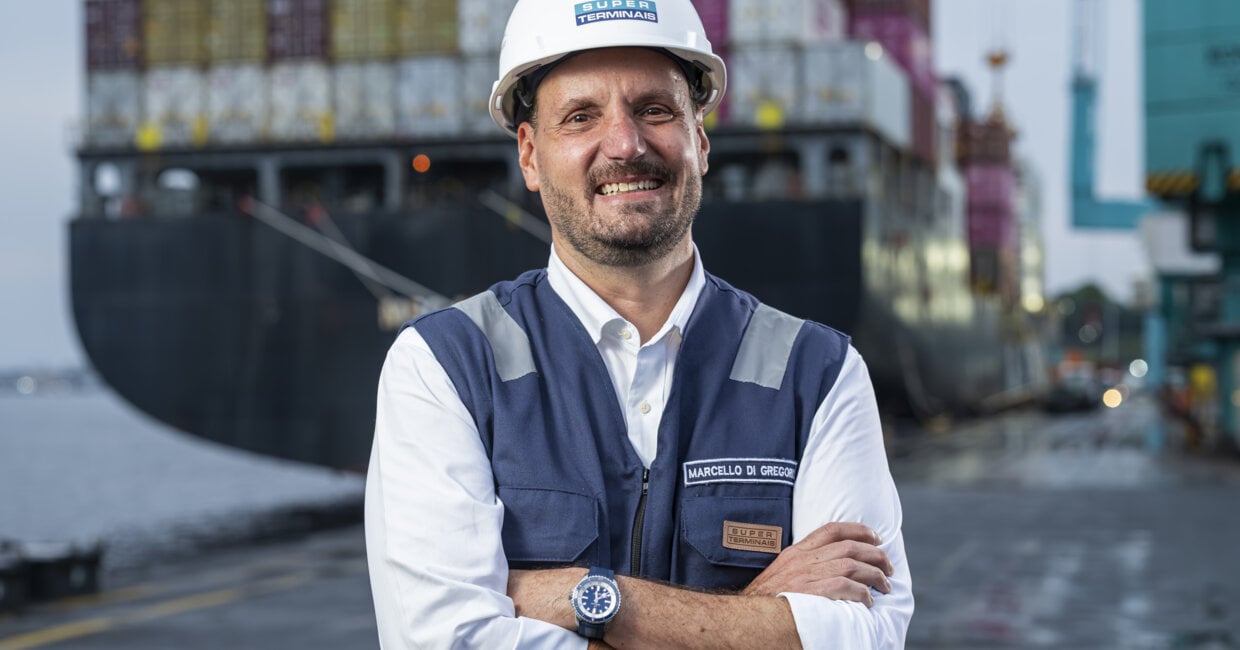
In 2022, amid the global challenges of the pandemic, Marcello assumed leadership of Super Terminais with a clear ambition: to position the terminal as a national benchmark for sustainability, technology, and operational excellence.
"When I took over the terminal, one of my main missions was to make it a benchmark, particularly in sustainability and technology — in both equipment and systems. We visited terminals in Brazil and abroad to learn from best practices. Operating in the heart of the Amazon requires different solutions, long-term vision, and reliable partners."
Logistics in the Amazon presents unique challenges. Extreme droughts and floods, alternating throughout the year, demand foresight, innovation, and resilience. "Amazon logistics is extremely complex. We have operated in this environment for 50 years. For six months we deal with drought conditions, and for another six months with flooding. River levels fluctuate between 17 and 20 meters every year. That is why we rely on floating modules to ensure operational continuity."
In recent years, these challenges have intensified due to climate change. Between 2023 and 2024, Manaus experienced the most severe droughts in its recent history. "In 2023, we went approximately 45 days without receiving vessels. Data showed that 2024 would be even more severe. We therefore made a strategic decision: relocating three crane-equipped modules to Itacoatiara, 300 kilometers from Manaus. There, we carried out a transshipment operation that handled 27 vessels and approximately 33,000 containers, totaling nearly 840,000 tons."
This was more than a logistical decision — it was a commitment to Brazil. Keeping cargo moving meant sustaining supply chains essential to millions of people.
Manaus has become one of Brazil’s most strategic industrial hubs, producing goods vital to the domestic market. "One hundred percent of televisions up to 55 inches produced and consumed in Brazil are manufactured in Manaus. The same applies to motorcycles up to 250 cc and air-conditioning units up to 32,000 BTUs. Brazil depends entirely on Manaus for these products."
Within this ecosystem, Super Terminais has established itself as a critical logistics link, handling approximately 50% of import containers and nearly 20% of coastal shipping containers arriving in Manaus. "Around 40% of the volume of motorcycles, electronics, and air conditioners entering and leaving Manaus passes through Super Terminais."
Asia plays a central role in this logistics network, supplying 60% of the raw materials used by Manaus-based factories through a route linking China, Panama, the Caribbean, and the Amazon River.
This 2,000-kilometer river journey — completed in just four to five days — symbolizes the integration of the rainforest with global trade.
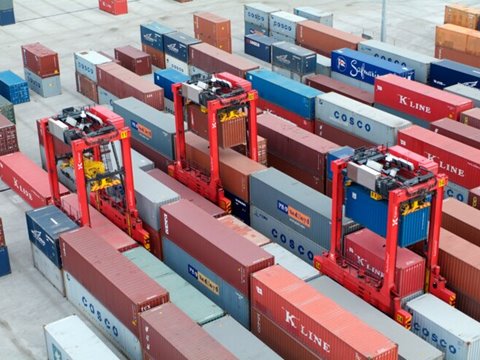
Modernization has been constant at Super Terminais. From the start of operations in 1996 to the installation of berths in 2003, the arrival of the first cranes in 2009, and the current expansion to 11 pieces of equipment and 600 meters of quay (with a projection of 720 meters), growth has always been guided by long-term vision.
A key enabler of this evolution has been the partnership with Kalmar.
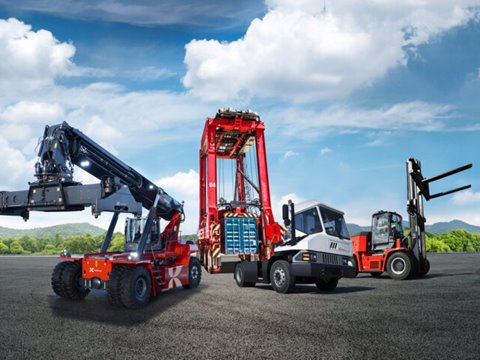
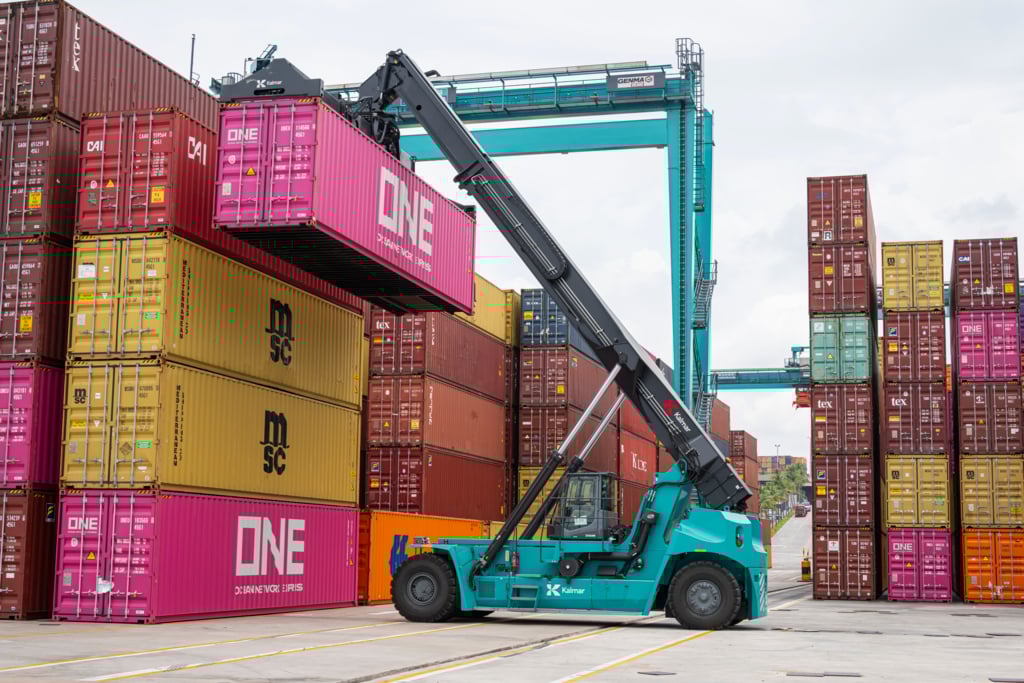
Kalmar has been our partner for nearly 30 years. We have grown together. Today, 100% of our equipment is Kalmar — terminal tractors, reach stackers, and empty handlers. We trust their quality, reliability, and service. This is a partnership built on shared values and a common vision for the future.
For Marcello, the future of Super Terminais goes beyond operational performance. It is deeply rooted in people, purpose, and environmental responsibility. "The legacy I want to leave is a solid, enduring, and human-centered company — one that cares for the community, respects the environment, and creates positive impact for the State of Amazonas, the North of Brazil, and the country as a whole.Although Super Terminais is 30 years old, the group will celebrate its 50th anniversary in 2027. Our strength lies in transparency, strong processes, respect for people, and commitment to the territory where we operate."
Looking ahead, his vision is clear. "Over the next ten years, we want Super Terminais to become a national benchmark — environmentally and technologically. With the investments we have made and partners like Kalmar, we are on the right path. In ten years, we want the most modern equipment, the best processes, and the highest operational standards in Brazil. Because here, every move counts."
From the waters of the Amazon to global trade routes the story of Marcello Di Gregorio and Super Terminais demonstrates how vision, partnership, and responsibility can transform extreme challenges into sustainable progress — and move an entire country forward.
Related articles
Subscribe and receive updates in your email
Suscríbase